Capital Gains Tax on Shares: The ₦150 Million Exemption Has a Second Test
Published October 11, 2026
What Nigerian investors and companies need to know about the ₦10 million gain limit, reinvestment relief, and why the old 10% assumption no longer holds
By Joe Adinma, FCA, FCTI — Managing Partner, Joe Adinma & Co. (Chartered Accountants)
Last updated: 6 October 2026
Picture two investors at a stockbroker's desk on Aba Road, Port Harcourt, in the middle of 2026. Both have just sold Nigerian shares. Both believe they are safely below the line. (They are illustrations, not clients.)
The first, Investor A, sold ₦120 million worth and made a gain of ₦15 million. She is relaxed because her sale was under ₦150 million. The second, Investor B, sold ₦160 million worth but made only ₦5 million. He is relaxed because his profit was small.
Under section 34 of the Nigeria Tax Act 2025, neither can rely on the basic share exemption.
The ₦150 million figure has travelled through WhatsApp groups and broker notes as if it were a simple ceiling. It is only half of a two-part test. And for a gain that fails the test, the old habit of multiplying by 10% now gives the wrong answer.
The Short Version |
Scope of this article |
Two Tests, Joined by “And”
Section 34 treats almost every form of property as a chargeable asset, shares included. It then carves out an exemption. Gains on disposal of shares in any Nigerian company are not chargeable where the “disposal proceeds, in aggregate, is less than ₦150,000,000 and the chargeable gain does not exceed ₦10,000,000 in any 12 consecutive months.”
That small word decides the matter. Like a generator that needs both fuel and a working plug, the exemption needs both conditions; one alone gives you no light. Add a third investor, C, who sells ₦140 million worth at an ₦8 million gain, and the pattern is clear:
Investor | Proceeds | Gain | Proceeds test (< ₦150m) | Gain test (≤ ₦10m) | Basic exemption |
A | ₦120m | ₦15m | Passed | Failed | Not available |
C | ₦140m | ₦8m | Passed | Passed | Available |
B | ₦160m | ₦5m | Failed | Passed | Not available |
Investor B's case matters most. Some published guides read the two limits as alternatives, as if breaching only one leaves the exemption intact. The statute joins them with “and”, so both must be met.
A gain of exactly ₦10 million passes, because the Act says “does not exceed”. NRS Information Circular 2026/03 paraphrases the test as a gain “less than ₦10 million”. On a gain of exactly ₦10 million the two wordings part company, and the Act, not the circular, is the law.
The proceeds limit has the mirror-image problem. The Act says proceeds must be “less than” ₦150 million. The Presidential Committee's November 2025 explanation said proceeds that “do not exceed ₦150 million”. At exactly ₦150 million the Committee's wording passes and the Act's fails, and again the Act governs.
The Twelve Months Roll
The test looks at aggregate proceeds “in any 12 consecutive months”, not one transaction and not one calendar year. Take an investor who sells in four lots:
January: ₦50 million
April: ₦45 million
August: ₦35 million
November: ₦30 million
No single sale comes near ₦150 million. Together they reach ₦160 million, and the basic exemption is gone. Splitting a sale into smaller lots does not help; the law counts every basket that leaves the market stall within the twelve months.
Because the window rolls, it looks forwards as well as backwards, and that raises a question the law does not answer. Suppose a March sale is exempt when it happens, but a sale the following January lifts the 12-month total above ₦150 million. Does the March exemption fall away after the event, and if so, in which year is the gain reported? Neither the Act nor Circular 2026/03 says.
Until it is addressed, anyone who trades actively needs a running schedule of disposals, not a year-end reconstruction, and should plan large sales with the whole window in view.
Your Bank Credit Is Not Your Gain
The tax is charged on the chargeable gain, not the cash received, and the exemption depends on both the aggregate proceeds and that gain. For shares on which no capital allowance has been claimed, section 39(b) deducts the cost incurred wholly and exclusively in acquiring them. Section 40 also allows incidental costs incurred wholly and exclusively for the disposal.
Simple computation | ₦ |
Disposal proceeds | 100,000,000 |
Less: acquisition cost | (80,000,000) |
Less: qualifying incidental disposal costs (illustrative) | (500,000) |
Chargeable gain | 19,500,000 |
Contract notes, broker statements and receipts for disposal costs are the evidence for every line above. They should be kept, not thrown away once the money lands.
A friendly price does not shrink the gain either. Where an asset is acquired otherwise than by a bargain at arm's length, section 36 deems the acquisition and disposal to take place at market value. That matters for sales to relatives, connected companies and group members.
The Old 10% Is Gone
The Capital Gains Tax Act, with its flat 10% rate, was repealed from 1 January 2026. NRS Information Circular 2026/03 confirms how gains are now taxed:
Companies add chargeable gains to their profits and pay tax at 0% (small companies) or 30% under section 56.
Individuals include chargeable gains in taxable income under section 28 and pay tax at the Fourth Schedule bands, which rise to 25%.
So a taxable ₦20 million gain is not simply ₦2 million of tax. The answer depends on who the seller is and on the rest of their income or profits.
Strictly, Nigeria no longer has a separate capital gains tax at all; gains are taxed as income. We use the familiar name because it is the one investors still search for.
For Companies, Model the Whole Computation
Section 27(1) defines a company's total profits as its total assessable profits from all sources, “including chargeable gains”. Section 59 imposes the 4% Development Levy on the assessable profits of companies other than small and non-resident companies.
The NRS has confirmed how the two fit together. Its Information Circular 2026/01 on companies income tax and the Development Levy, published on 29 June 2026, states that “chargeable gains from the disposal of a chargeable asset are added to the profit adjustment to arrive at assessable profit”. Its model computation then charges the “development levy @ 4% of assessable profit”. So for a company within the levy's scope, a taxable gain carries 30% plus 4%. Because the levy is charged on assessable profit, it is computed before losses brought forward and capital allowances are deducted.
For constituent entities of multinational groups and companies with turnover of ₦20 billion or more, section 57 requires a 15% minimum effective tax rate. That test runs on the company's whole-year results; it is not an extra rate to add to a single gain.
Filing has moved as well. Circular 2026/03 says gains on or after 1 January 2026 are assessed and filed with the company's income tax return. Its own example places a 2026 disposal in the 2027 year of assessment. The old 30 June and 31 December filing windows survive only for 2025 disposals, and the last of those deadlines, 30 June 2026, has passed. Any compliance calendar that still shows them for 2026 disposals needs updating.
Reinvestment Can Change the Answer
Section 34 contains a second, separate relief. Gains are not chargeable where the proceeds, “notwithstanding the threshold”, are reinvested within the same year of assessment in shares of the same or other Nigerian companies. So failing the two tests is not the end of the story.
Take an investor who sells for ₦200 million with a ₦40 million gain. Both tests fail. If the full ₦200 million is reinvested in time, the gain is protected.
Note the word proceeds. Reinvesting only the ₦40 million profit does not protect the gain. The law follows the money that leaves the market, not the profit that was made.
Where only part is reinvested, the Act says tax “shall accrue proportionately on the portion of the proceeds which are not reinvested.” It does not spell out the arithmetic. The natural reading taxes the same fraction of the gain:
Partial reinvestment | ₦ |
Disposal proceeds | 200,000,000 |
Chargeable gain | 40,000,000 |
Proceeds reinvested | 150,000,000 |
Proceeds not reinvested (25%) | 50,000,000 |
Gain exposed to tax (25% × ₦40m) | 10,000,000 |
Before a large rebalance, decide how much cash you will actually take out, and model the tax on that figure.
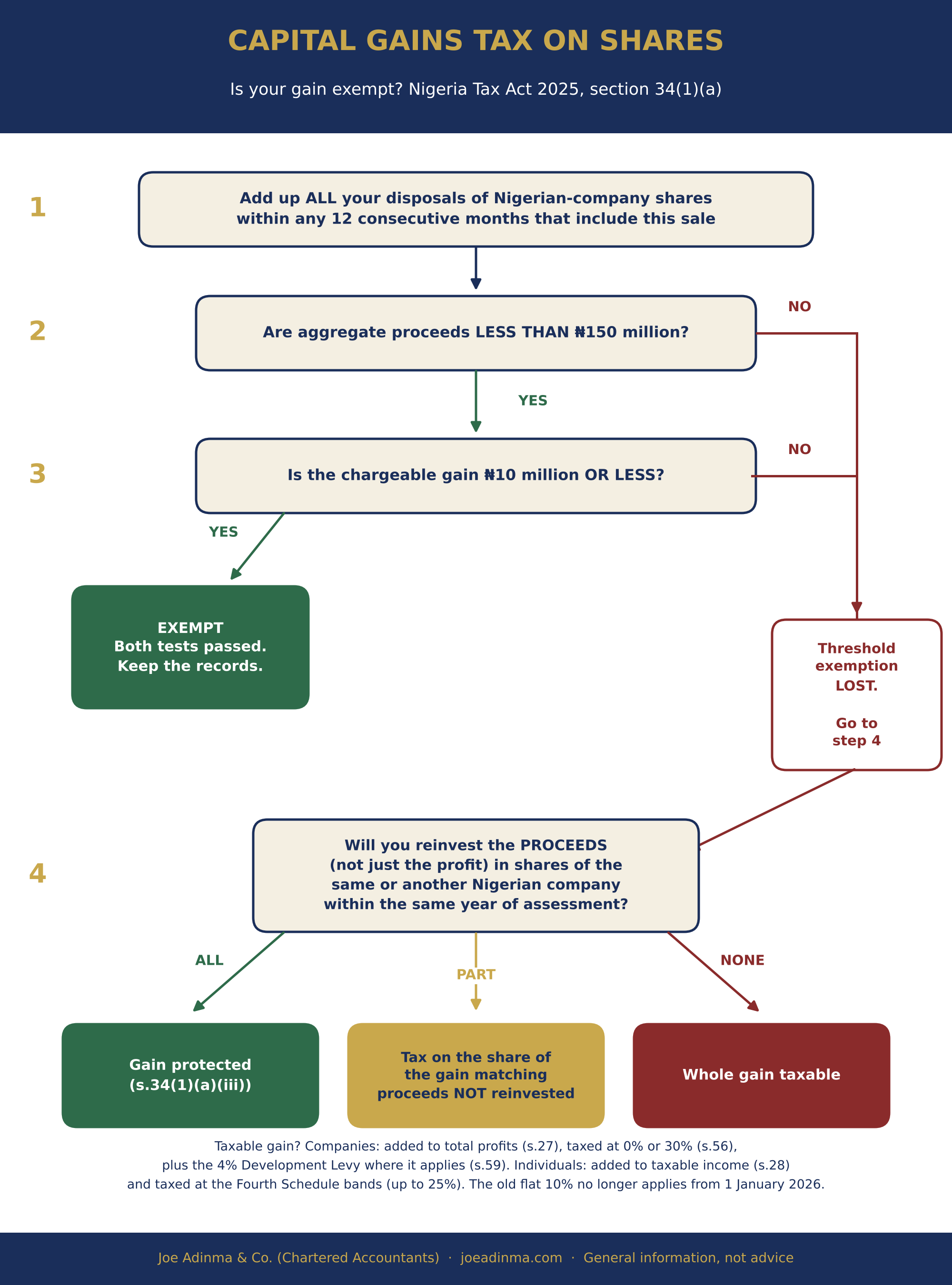
The whole test on one page: section 34(1)(a) of the Nigeria Tax Act 2025.
Open question: how long do you have to reinvest? |
Shares bought before 2026: the announced reset is not in the Act |
Losses Count Too
The new framework recognises losing trades as well as winning ones. For individuals, section 28(3)(b) allows “the amount of loss incurred on the disposal of a chargeable asset” to be deducted in arriving at total income. The provisos that govern how losses are relieved are drafted mainly around trading profits, so exactly how a share loss offsets a share gain is not spelt out.
For companies, the drafting is awkward. Section 27(1) deducts “any loss ascertained in accordance with subsection (6)”, but subsection (6) deals only with losses on digital or virtual assets. The general loss rules sit as provisos under subsection (5), which concerns capital allowances. The cross-reference looks like a drafting error, and it leaves unclear how, or whether, a company can set a loss on shares against a gain on shares. Circular 2026/01 fills part of the gap, but only part. It allows a deduction for “losses from the disposal of chargeable assets employed in that trade or business”, and adds that “the loss can only be deducted from the trade or business in which the loss was incurred.” Shares held as an investment, outside the company's trade, are not obviously within those words. A corporate investor should take advice before assuming one shelters the other. Either way, a portfolio record that shows only the winners tells half the story.
Where the Law and the Guidance Don't Line Up
Pulling the threads together, the regime has six points where the Act, the official explanations and practical compliance do not match cleanly. In each case the Act is the law; the rest tells you where disputes are likely.
Issue | The Act says | Guidance or practice says | Why it matters |
Proceeds limit | s.34: “less than” ₦150m | Committee, Nov 2025: “do not exceed” ₦150m | Exactly ₦150m fails under the Act |
Gain limit | s.34: “does not exceed” ₦10m | Circular 2026/03: “less than” ₦10m | Exactly ₦10m passes under the Act |
Reinvestment period | “Within the same year of assessment” | Committee: “within 12 months” | Deadlines can differ by months |
Rolling window | “Any 12 consecutive months” | No guidance on a later sale tipping an earlier one | An earlier exemption may be reopened |
Company losses | s.27(1) refers to losses under subsection (6), which covers only digital assets | Circular 2026/01: losses on chargeable assets “employed in that trade or business” | A loss on investment shares may get no relief |
Pre-2026 cost base | No reset in the Act | Committee: higher of cost or 31 Dec 2025 price | The taxable gain can differ widely |
What could change |
Before You Sell: Keep This Schedule
Anyone with a material Nigerian equity portfolio should keep a disposal schedule showing:
acquisition date, quantity and original cost, with contract notes;
the 31 December 2025 closing price or value for shares held before 2026;
date and proceeds of each disposal, and the qualifying disposal costs;
the chargeable gain or loss on each disposal, losses included;
running total of disposal proceeds and gains over the rolling 12 months;
amount and date of each reinvestment, and the shares bought with it;
whether the seller is an individual or a company, and its financial year-end.
For an active investor, that schedule now matters as much as the broker's statement.
Back at the Broker's Desk
Return to the two investors on Aba Road. Investor A's sale was small enough, but her gain was not. Investor B's gain was small enough, but his sale was not. Both can still protect their gains by reinvesting the proceeds in time, and both should know the taxable gain is no longer a matter of 10%.
The ₦150 million figure is the part of the river everyone can see; the second test is the current underneath. Together with the reinvestment rule, it decides the tax. The time to work through them is before the broker executes, not after the NRS asks for the records.
If you are planning a significant share disposal and would like the computation reviewed first, Joe Adinma & Co. can help.
How we sourced this |
Related Reading
Nigeria's 15% Minimum Effective Tax Rate: What Replaced the Old Minimum Tax?
The Tax Reform Isn't Finished — the Government Just Admitted It
Nigeria's Real Estate Sector Has a New Tax Rulebook — Is Your Portfolio Ready for It?
Sources
Nigeria Tax Act, 2025 (Official Gazette No. 117, Vol. 112), sections 26–28, 33–45, 56–57 and 59.
Nigeria Revenue Service, Information Circular No. 2026/03: Clarification on Ascertainment of Chargeable Gains, 29 June 2026.
Presidential Fiscal Policy and Tax Reforms Committee, “What You Need to Know About the New Capital Gains Tax Rules” (via AllAfrica), 12 November 2025.
Nigeria Revenue Service, Information Circular No. 2026/01: Ascertainment of Income Tax of Companies and Development Levy, 29 June 2026 (copy published by KPMG Nigeria).
Nairametrics, “Capital Gains Tax: Oyedele clarifies past gains won't be taxed under new law”, 12 November 2025.
ThisDay, “FG Sets up Technical Committee to Review 2025 Tax Acts”, 18 September 2026.
New Telegraph, “FG Sets Up Panel To Review 134 Public Inputs On Tax Reforms”, 17 September 2026.
The Sun, “FG begins review of tax laws, fiscal policies”, 18 September 2026.
This article is general information on the law and NRS guidance as at 6 October 2026. It is not tax, legal or investment advice. The outcome of any disposal depends on the seller's circumstances, the full transaction history and the law and guidance in force at the time. Parts of this regime are under active review.