
My Sales Are Up. My Profits Look Great. So Where Is My Money?
Published June 5, 2026
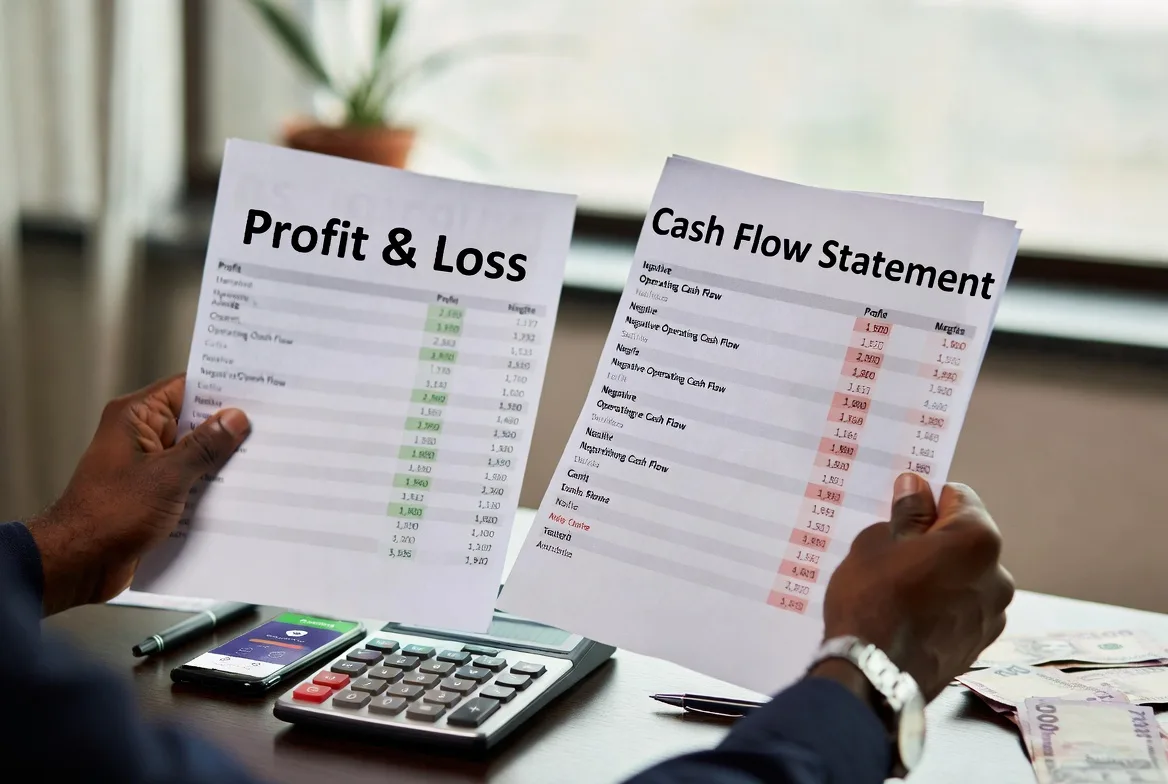
Every week, I sit across from business owners in Port Harcourt who are deeply frustrated. Their sales figures are impressive. Their accountant is telling them they are profitable. Yet they struggle to pay salaries, cannot afford new equipment, and feel perpetually broke. They ask me the same question: "Joe, where is my money?"
This is not a sign that something is wrong with your business. It is a sign that you — like most business owners — have been measuring the wrong thing. There is a fundamental difference between profit and cash, and confusing the two is one of the most common and dangerous mistakes in business management.
Let me explain this clearly, without jargon, and with real Nigerian business context.
"Profit is an opinion. Cash is a fact. You can debate whether you are profitable — but you cannot debate whether there is money in your account."
The Core Distinction: Accrual vs. Cash
When your accountant prepares your financial statements, they follow a globally accepted principle called accrual accounting — and this is the root of the confusion. Under this method (required by IFRS and every credible accounting standard), income is recorded when it is earned, not when cash is received. Expenses are recorded when they are incurred, not when they are paid.
This means your Profit & Loss (Income Statement) can show a ₦50 million profit for the year — and yet your bank account could simultaneously show a negative balance. Both figures are technically correct. They are simply measuring different things.
Illustrative Scenario · A Port Harcourt Trading Company
Imagine you supply goods worth ₦100 million to three large corporate clients in Q4. You issue invoices. Your accountant records ₦100 million in revenue. After deducting your cost of goods (₦55m) and operating expenses (₦20m), your Income Statement shows a net profit of ₦25 million.
But all three clients are on 90-day payment terms. None of that ₦100 million has hit your bank account. Meanwhile, you already paid your suppliers, paid your staff, and paid your rent. Your actual cash position is deeply negative.
Reported Net Profit: ₦25m ✓
Actual Cash Position: ₦(18m) ✗
This is not fraud. This is not error. This is simply how accounting works — and why the Cash Flow Statement (the third financial statement, often ignored) is arguably the most important document your accountant produces.
Seven Reasons Your Cash Disappears While Profits Rise
Let us go deeper. Here are the most common reasons profitable businesses run out of cash — all grounded in real accounting principles.
1. Your Debtors Are Eating Your Cash (Trade Receivables)
Every naira you are owed by customers is profit on paper but zero in your account. The longer your credit terms, or the more customers delay payment, the wider the gap between profit and cash. In Nigerian markets, 60–120 day payment cycles are common, especially with government contractors and large corporates. This is the single biggest culprit.
2. Inventory Build-Up (Stock You Have Paid For But Not Yet Sold)
When you purchase goods or raw materials, cash leaves your account immediately. But no expense appears on your Income Statement until that stock is sold. If you are stocking up aggressively to meet demand, your cash is sitting on a shelf, recorded as an asset — not an expense — and your profits look fine while your wallet is empty.
3. Capital Expenditure (You Invested in Assets)
Suppose you bought a ₦30 million generator, vehicle, or equipment. Under IFRS (IAS 16), you do not expense ₦30 million immediately. You capitalise it as an asset and charge only depreciation — say ₦3 million per year — to your P&L. So your profit is barely dented, but ₦30 million in cash is gone. Growth investments are invisible to the Income Statement but brutally visible in your bank account.
4. Loan Repayments (Principal Is Not an Expense)
Many business owners are shocked to learn this: when you repay a bank loan, only the interest portion hits your P&L as an expense. The principal repayment is a balance sheet transaction — a reduction in liability — and does not reduce your profit. Yet that principal repayment takes real cash out of your account every month. A ₦5 million monthly loan repayment with ₦500k in interest means ₦4.5 million disappears from your cash with no impact on profit.
5. You Are Paying Suppliers Faster Than You Are Collecting
Your suppliers demand 30-day payment. Your customers insist on 90-day terms. That 60-day mismatch is a cash gap you must fund entirely from your own resources, every single cycle. As your sales grow, this gap grows proportionally. Paradoxically, the faster you grow, the worse your cash position can become.
6. Tax Payments Are Larger Than Your P&L Suggests
Your accountant may show a ₦5 million tax charge in the Income Statement based on current-year estimates. But in reality, you may be paying taxes for prior years, making quarterly instalments under the Pay-As-You-Earn tax system, or settling withholding tax and VAT liabilities that accumulated. Cash tax outflows frequently exceed the P&L tax charge significantly.
7. Owner Drawings, Dividends, and Transfers Out of the Business
This one is sensitive but important. Many owner-managed businesses — particularly in Nigeria — have an informal flow of funds between the business and the owner's personal accounts. These withdrawals do not appear as expenses on the P&L (or should not), but they drain cash relentlessly. If you are drawing money for personal use and it is not accounted for properly, the numbers will never reconcile.
Why This Matters Beyond the Numbers
The practical implication is stark: businesses do not collapse because they are unprofitable. They collapse because they run out of cash. History — and daily Nigerian business reality — is littered with companies that had strong order books, growing revenues, and positive profit margins right up to the moment they could not pay their next salary run.
This is why serious lenders, sophisticated investors, and experienced CFOs spend far more time analysing cash flow statements and working capital ratios than they do studying the Income Statement. Profit tells you if your business model works. Cash tells you if your business will survive the next 90 days.
"A business that is profitable but cash-starved is like a man who owns land worth millions but cannot afford tomorrow's lunch. The wealth is real — but the timing is killing him."
The Three Financial Statements You Must Read Together
Under IFRS and good accounting practice, a complete set of financial statements has three primary components that must be read as a system, not in isolation:
The IFRS Financial Statement Trilogy
① Statement of Profit or Loss (Income Statement)
Tells you if your business model is economically viable — whether your revenues exceed your costs over a period. Prepared on accrual basis. Does not tell you about cash.
② Statement of Financial Position (Balance Sheet)
A snapshot of what your business owns (assets), what it owes (liabilities), and the residual equity at a point in time. Includes your receivables, inventory, payables — the working capital drivers of your cash gap.
③ Statement of Cash Flows (IAS 7)
The most misunderstood and most neglected statement. It shows exactly where cash came from and where it went, categorised into three activities:
Operating Activities — Cash generated or consumed by your core business operations. The most critical section. A consistently negative operating cash flow is a red flag regardless of profits.
Investing Activities — Cash spent acquiring or disposing of long-term assets. Negative is often a sign of healthy growth investment.
Financing Activities — Cash flows from loans raised, loans repaid, dividends paid, or new equity injected. Explains funding movements.
The reconciling item between profit and operating cash flow is one of the most instructive numbers in accounting. It shows you, line by line, exactly why your profit and cash differ — adjusting for depreciation, movements in receivables, inventory changes, and payables. If your accountant is not providing and explaining this statement, you should insist on it immediately.
What Should You Do About It?
1. Request a Cash Flow Statement at Every Review
Do not accept a P&L in isolation. Every financial review — monthly or quarterly — should include a Cash Flow Statement or at minimum a rolling cash flow forecast. You need to see not just where you are, but where your cash is heading over the next 30, 60, and 90 days.
2. Monitor Your Working Capital Closely
Working capital — essentially your current assets minus current liabilities — is the financial engine of your short-term liquidity. Track your Debtor Days (how long customers take to pay), your Creditor Days (how long you take to pay suppliers), and your Inventory Days (how long stock sits before it is sold). The relationship between these three ratios determines whether your business generates or consumes cash as it grows.
3. Separate Business and Personal Finances Completely
This is foundational. Every naira that crosses between your personal account and your business account must be properly categorised — as salary, dividend, loan, or capital injection. Without this discipline, your financial statements will always be unreliable and your cash position impossible to understand.
4. Plan Your Cash, Not Just Your Profit
Build a 13-week rolling cash flow forecast as a management tool. It is not difficult, and it changes everything. You will see cash pinch points weeks in advance and have time to act — renegotiate a supplier payment, accelerate a collection, or arrange a short-term credit facility — rather than reacting in crisis.
5. Understand the Timing of Your Tax Liabilities
Corporate tax, VAT, WHT, and PAYE all have their own payment cycles and triggers. Under Nigeria's tax framework, mismatches between when liabilities are recognised and when they must be settled in cash can create sudden, significant outflows. Your tax position should always be reviewed as a cash planning matter, not just a compliance matter.
In Conclusion
You are not doing anything wrong. Your accountant is not lying to you. Your profit figure is real. But profit and cash are two entirely different measurements of your business health — one tells you what you earned, the other tells you whether you can function. You need both to manage a business well.
The great businesses — the ones that survive economic downturns, fund their own growth, and build lasting wealth for their owners — are managed by people who understand both their income statement and their cash flow intimately. They do not just ask "are we profitable?" They ask "do we have cash, will we have cash, and what is driving the difference?"
That is the question I encourage every business owner I work with to start asking. And if you need help building the financial management tools to answer it — that is exactly what we do.
Need Clarity on Your Business Finances?
Joe Adinma & Co. helps owner-managed businesses and SMEs in Rivers State and beyond build the financial reporting and management frameworks they need to grow with confidence.