
When the Numbers Lie, the Company Dies
Published June 10, 2026
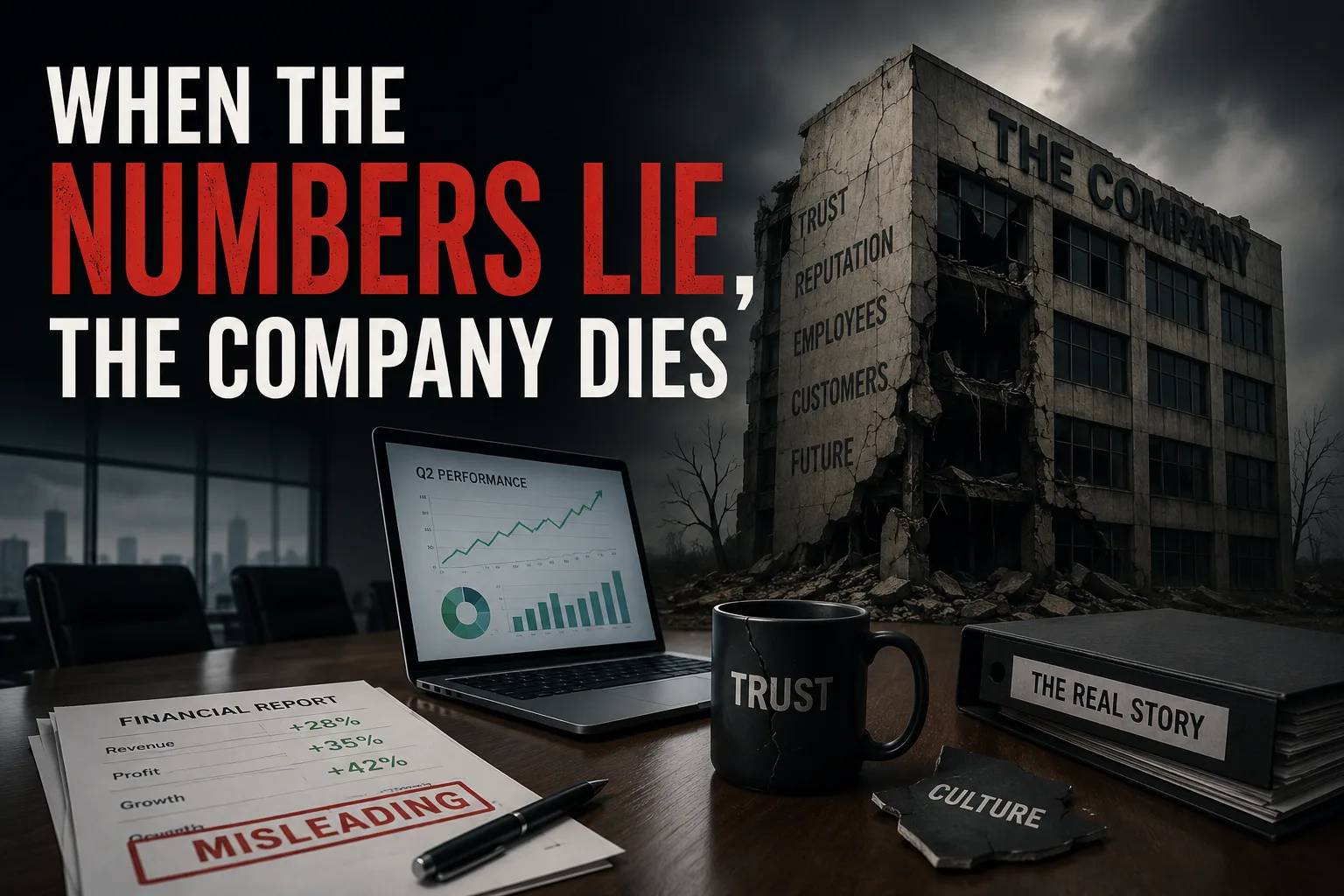
Let me tell you about a company you probably know.
Not by name — but by story.
They had a good product. Strong market. Loyal customers. The MD was sharp, the sales team was hungry, and revenue was climbing. From the outside, everything looked like momentum. From the inside, the business was quietly bleeding to death — and nobody in the finance department had the skills to read the wound.
The tax liabilities had been miscomputed for three years running. VAT returns were filed on cash basis when the law demanded invoice basis. Intercompany transactions were undocumented. The fixed asset register had not been reconciled since 2021. And when a tier-one bank requested audited IFRS-compliant financials before approving a ₦500 million facility, the company could not produce them.
The loan didn’t happen. The expansion didn’t happen. A competitor — better governed, better financed, better advised — took the market instead.
Nobody stole anything. Nobody was corrupt. The business simply had the wrong people doing the wrong things in the most consequential department in the company.
That is not bad luck. That is a leadership decision — and its consequences were entirely predictable.
The Most Expensive Lie in Nigerian Business
There is a dangerous assumption circulating in boardrooms, family businesses, and SME offices across this country. It sounds reasonable. It feels prudent. It goes like this:
“We’re not big enough yet to invest heavily in finance. We’ll sort that out when we grow.”
This is exactly backwards — and it has quietly killed more promising Nigerian businesses than any recession, any policy reversal, or any market disruption ever has.
You do not invest in a strong finance function because you have grown. You grow because you invested in a strong finance function. The causality runs in one direction only — and too many businesses have it dangerously reversed.
The companies that scale, that attract serious capital, that survive regulatory storms and build enterprises that outlast their founders — they are not simply the ones with the best products. They are the ones where the accountant is involved in every major business decision, where financial reporting is treated as a strategic weapon rather than a compliance chore, and where the numbers tell the truth even when the truth is deeply uncomfortable.
What Finance Really Is — And What It Isn’t
Ask most business owners what their finance department does and they will say: “They handle the accounts. They pay salaries. They deal with the auditors.”
That description belongs to a bookkeeping function. Not a finance function.
A genuine finance function does something far more consequential. It answers the questions that determine whether your business is still standing in five years:
• Where exactly is value being created in this business — and where is it being quietly destroyed?
• If your biggest client delays payment by 90 days this quarter, can you meet payroll without panic?
• What is the real after-tax cost of that equipment lease versus outright purchase?
• If the naira depreciates another 25%, what happens to your USD-denominated obligations?
• Are your transfer pricing arrangements with related parties defensible under NRS and state revenue authority scrutiny?
• What will your effective tax rate be under the current Finance Act provisions — and have you structured to optimise it lawfully?
These are not accounting questions. They are survival questions. And they cannot be answered by a junior accounts clerk with a copy of Tally, a stack of unsigned payment vouchers, and a prayer.
The Governance Deficit Nobody Is Talking About
Nigeria has a growing corporate governance problem — and a significant part of it lives inside the finance function.
CAMA 2020 raised the bar on director accountability in ways many boards have still not fully absorbed. The Finance Acts have progressively tightened compliance obligations across CIT, VAT, and WHT. The Nigeria Revenue Service (NRS) has deployed technology that can now cross-reference VAT invoices, withholding tax credits, and company income tax returns in ways that were simply impossible five years ago. State internal revenue services are conducting Best of Judgement assessments against businesses that have not filed — and those assessments are not conservative. They are designed to hurt.
In this environment, a poorly staffed finance function is not merely an operational weakness. It is a legal and regulatory liability sitting on your balance sheet, accruing penalties you have not provisioned for, compounding quietly — until the day a revenue officer walks through your door and it cannot be ignored any longer.
I have sat across from business owners who were genuinely shocked to discover that their company owed three years of underpaid VAT. That WHT deductions had been made from vendors but never remitted to the revenue authority. That their audited accounts contained material misstatements that had technically triggered default clauses in their loan agreements — clauses the bank had not yet enforced, but legally could.
Not because these owners were dishonest. Because nobody in their finance team was equipped, experienced, or empowered enough to catch it.
The external auditor is not your internal safeguard. The tax consultant you call once a year is not your real-time risk manager. These are after-the-fact interventions — useful, necessary, but fundamentally reactive. What protects you in real time, every single day, is the quality of the accountants inside your finance function — running the numbers, asking the hard questions, and refusing to let uncomfortable truths stay buried.
Your Financial Statements Are a Marketing Document
Here is something that does not get said enough in Nigerian business circles — and it needs to be said plainly:
“Your financial statements are a marketing document.”
When a bank, a private equity firm, a development finance institution, or a serious trade partner evaluates your business, the first thing they reach for is your financials. Not your pitch deck. Not your award plaques. Not the profile on your website. Your financial statements.
And what they are looking for — before they assess anything else — is whether they can trust what they are reading.
IFRS-compliant financials, properly prepared, with adequate disclosures, consistent accounting policies, and a clean audit opinion, communicate something that no amount of charm or salesmanship can replicate: this company is led by people who take financial integrity seriously. That signal has a hard monetary value. It lowers your cost of capital. It compresses credit approval timelines. It unlocks financing instruments — bonds, project finance, Bank of Industry facilities, Africa Finance Corporation funding, equity participation — that are permanently closed to companies whose numbers cannot withstand professional scrutiny.
Poorly prepared financials communicate something else entirely. They communicate risk. Opacity. Uncertainty. And in capital markets — formal or informal — risk is always priced. Usually at a rate that makes meaningful growth impossible.
The irony is devastating: the companies that most need external capital are often the ones whose financial reporting is weakest — and therefore the ones who pay the highest premium for money, or simply cannot access it at all.
What Forward-Thinking Companies Are Actually Doing
The businesses building something enduring in this country are not waiting for the right time to get their finance function right. They are treating it as a founding investment — as fundamental as their operations, their technology, and their market strategy. And they are doing it with intention.
i. Giving the Head of Finance a seat at the decision-making table.
In a forward-thinking Nigerian company, the Finance Director or Chief Accountant is in the room when pricing decisions are made, when contracts are structured, when new markets are being evaluated. Not waiting outside to be informed of what was decided — and not called in only when something has gone wrong.
ii. Hiring for depth, not just compliance.
There is a world of difference between an accountant who can produce a trial balance and one who can read it critically, challenge its assumptions, and extract strategic intelligence from it. The former keeps you compliant. The latter keeps you competitive. Nigerian businesses need more of the latter.
iii. Building genuine IFRS capability in-house.
Not outsourcing all financial reporting and hoping the consultant gets it right. Actually understanding how IFRS 9 affects the recognition of financial assets. How IFRS 15 determines when revenue is recognised on long-term contracts. How IFRS 16 brings lease obligations onto the face of the balance sheet — where lenders and investors can see them.
iv. Investing in real financial planning and analysis.
Rolling forecasts. Stress-tested cash flow models. Scenario analysis that asks what happens if — not just what happened. Monthly management accounts that are ready within two weeks of month-end, not two months. Variance reports that pursue the why relentlessly. This discipline is what separates companies that navigate crises from companies that are consumed by them.
v. Using technology with intelligence.
Accounting software, automated reconciliations, ERP systems — adopted deliberately, with qualified accountants at the centre interpreting and validating outputs. Technology amplifies strong financial judgement. It cannot manufacture it where none exists.
vi. Building a culture where the numbers tell the truth.
This is the hardest one — and the most important. Companies where the finance team is pressured to make the numbers look better than they are do not have a finance problem. They have a governance problem. And governance problems, consistently avoided, always resolve themselves. Catastrophically. Often in the presence of a revenue officer, a liquidator, or a judge.
A Direct Word to Business Owners and Boards
If any part of this article has felt uncomfortably familiar — the accounts department that is perpetually behind, the tax position you would rather not examine too closely, the financial statements that are always six months late and never quite trusted by the people who receive them — I want to say something directly:
“The cost of getting this right is a fraction of the cost of getting it wrong.”
A well-structured, properly resourced finance function — staffed with qualified, experienced accountants who are empowered to do their jobs without interference — is not overhead. It is a return-generating investment in reduced tax exposure, stronger financing terms, sharper strategic decisions, and the kind of institutional credibility that compounds quietly over time.
More than that: it is the difference between a business that reacts to its financial reality and one that actively shapes it.
Nigeria’s most enduring enterprises did not build their reputations on product alone. They built them on financial discipline, governance integrity — the kind that survives a regulatory visit and withstands the scrutiny of a serious investor — and the willingness to invest in the functions that protect and multiply value, even before those investments felt urgent.
The question before you is not whether you can afford to take your finance function seriously.
The question — the one that will answer itself, one way or another — is whether you can afford not to.