When the Numbers Look Right but Something Is Wrong: How Forensic Accounting Uncovers Fraud and Financial Leakage
Published August 10, 2026

In the mid-2000s, one of Nigeria's most trusted household names published audited accounts that looked, by every conventional measure, exactly right. The numbers balanced. The auditor's opinion was unqualified — a clean bill of health, no red flags, no exceptions noted. Shareholders had no reason to doubt what they were reading — until they did.
We'll name the company shortly. First, the number that explains why it took years for anyone to notice.
A clean audit opinion is not a certificate that no fraud occurred. Auditing standards require auditors to specifically consider the risk of fraud, and a properly conducted audit does look for it. But an audit provides reasonable, not absolute, assurance — and collusion, management override of controls, and deliberate concealment can defeat even a rigorous audit process. That gap between reasonable assurance and absolute certainty is where forensic accounting operates.
Here is the number every director should sit with: according to the Association of Certified Fraud Examiners' Occupational Fraud 2024: A Report to the Nations — the largest fraud study in the world, drawn from 1,921 confirmed cases across 138 countries — 43% of occupational fraud cases were detected through tips, more than three times the next most common detection method. Over half of those tips come from employees; the rest from customers, vendors, and outsiders who noticed something didn't add up.
Not the annual audit. Not internal controls working as designed. A tip. For most organisations that get defrauded, the system did not catch it — someone talked.
43%
of occupational fraud is detected by tip-off — more than 3x the next most common method
Source: Association of Certified Fraud Examiners (ACFE), Occupational Fraud 2024: A Report to the Nations, 13th edition
So, What Exactly Is Forensic Accounting?
Forensic accounting combines accounting, auditing, investigative technique, data analysis, and evidence gathering to establish financial facts that can withstand challenge — by a board, a regulator, or a court. Where a statutory audit forms an opinion on whether financial statements are fairly presented as a whole, forensic accounting exists to answer a narrower, more specific question: what actually happened to this money, this asset, or this set of numbers.
In practice, a forensic accountant may be engaged to investigate:
Procurement fraud and inflated or fictitious contracts
Payroll fraud and ghost workers
Diversion of company funds
Suspicious or unauthorised bank transactions
Fictitious suppliers and undisclosed related-party arrangements
Management override of controls
Inventory and asset misappropriation
Financial statement manipulation
Unauthorised bank charges and disputed loan interest
Shareholder and partnership disputes
Asset tracing and loss quantification
Whistleblower allegations requiring independent verification
The output is rarely a management letter. It is usually a report, a set of independently reconstructed records, or expert testimony built to survive cross-examination.
The Three Faces of Fraud
Not all fraud looks alike, and the type matters more than most organisations realise.
Asset misappropriation — theft of cash, inventory, or company property — is the most common form, at roughly 89% of cases, and individually the least costly of the three.
Corruption — bribery, kickbacks, conflicts of interest — features in nearly half of all cases and tends to run alongside the other two.
Financial statement fraud — deliberately misstating the numbers themselves — is the rarest, at around 5% of cases, and by a wide margin the most destructive: it typically costs several times more per case than a straightforward asset misappropriation scheme.
The organisation worrying about a dishonest cashier is worrying about the cheapest version of fraud. The version that sinks companies is the manipulated financial statement — exactly the version a routine audit finds hardest to catch, because it is designed and executed by the people closest to the numbers, with the authority to override the controls meant to stop it.
Who Actually Does This
Fraud committed by owners and executives causes losses more than seven times greater than fraud committed by ordinary employees. Fraud involving three or more people working together causes losses roughly four times greater than fraud committed alone.
Together, these two facts should reframe how most boards think about risk. The greatest exposure is not the junior staff member with access to petty cash. It is the senior person with authority to override a control, working with one or two others who won't ask questions — precisely the profile a standard audit, built around testing controls rather than testing people, is worst positioned to catch.
The Fraud Triangle: Why It Happens
The classic Fraud Triangle identifies three conditions commonly associated with occupational fraud:
Pressure — a financial problem the person feels they cannot share: debt, a lifestyle they can't sustain, targets they can't hit honestly.
Opportunity — weak or overridden controls that make the theft or manipulation possible without immediate detection.
Rationalisation — the story the person tells themselves to make it feel justified: “I'm only borrowing it,” “I'm underpaid anyway,” “everyone does it.”
Where any one of these is genuinely absent, occupational fraud becomes far less likely. Most Nigerian organisations spend all their control energy on the middle leg — segregation of duties, approval limits, IT access — with no visibility into the other two at all. Forensic accounting is one of the few disciplines built to look at all three.
Nigeria Has Already Paid This Lesson — Repeatedly
That household name was Cadbury Nigeria Plc. In December 2006, Nigeria's Securities and Exchange Commission confirmed what its own board had feared: the company's accounts had been overstated by roughly ₦13–15 billion across 2002 to September 2006 — inflated profit, manipulated closing inventory, a growth story built to hit targets rather than reflect reality. Managing Director Bunmi Oni — who had just been named Chief Executive of the Year — and Finance Director Ayo Akadiri were sacked. The external auditor, Akintola Williams Deloitte, had audited the company for more than 40 years; the SEC found it had been negligent in that role and fined it accordingly, alongside Cadbury Nigeria itself and the share registrars. The company's share price collapsed.
Forty years of statutory audits had not surfaced it. It took a dedicated, board-commissioned investigation — the kind forensic accounting is built for — to establish what had actually happened.
Nigeria has continued to test this lesson. In 2026 alone, the EFCC has arraigned multiple companies over alleged financial crimes running into billions of naira — foreign exchange schemes, inflated contracts, diverted public funds. These are allegations still working through the courts, not established findings, but the pattern is a familiar one: a control that existed on paper and was never tested, or a number nobody outside the organisation had reason to check — until someone finally did.
Where the Real Money Leaks: Your Bank Statement and Your Loan Account
Not everything that costs an organisation money needs a whistleblower or a court case to surface. Some of it is sitting in a bank statement today — but finding it takes more than a glance at the closing balance. It takes the kind of disciplined, line-by-line reconciliation that forensic training is built for: knowing what a legitimate charge looks like, what the regulator actually permits, and what an unexplained or duplicated entry might really represent.
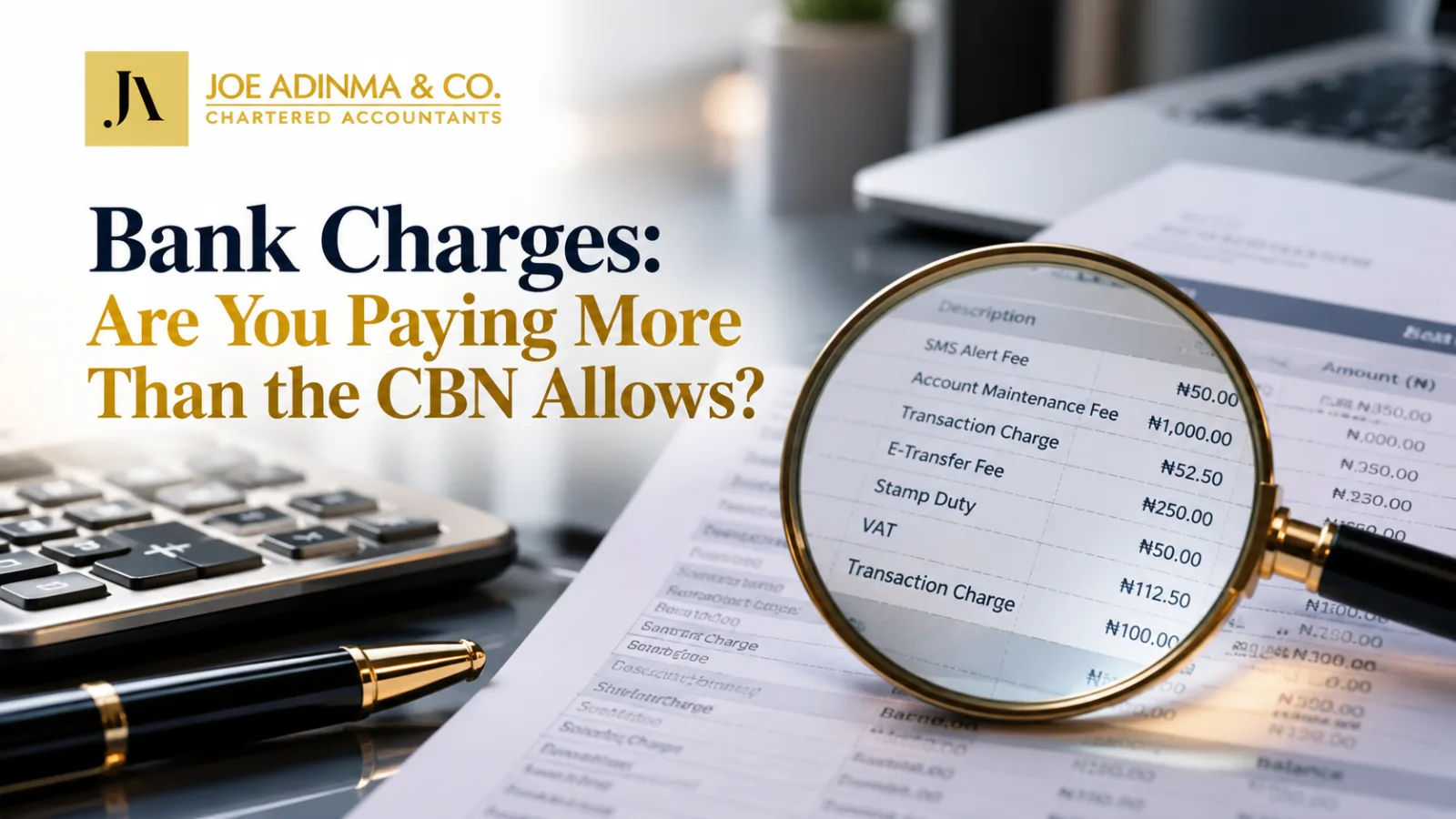
We have been fielding this complaint from businesses for years — but the volume has been climbing sharply of late: charges on their accounts they cannot explain. Stamp duty deducted more than once on the same transaction. SMS alert fees for alerts never sent. “Maintenance” charges that don't match what the bank is actually permitted to bill. Individually, each one looks too small to chase. Across twelve months and multiple accounts, the number stops being small — and while some of it may simply be error or misapplication rather than deliberate overcharging, the effect on the business is the same either way.
This is a live regulatory issue, not a fringe complaint. On 21 April 2026, the Central Bank of Nigeria issued an exposure draft of its revised Guide to Charges by Banks and Other Financial Institutions, introducing fee caps and stricter disclosure requirements — part of a broader push that followed the CBN Governor's own public acknowledgment of rising customer complaints about confusing debit alerts and unexplained deductions. Very few businesses have read the Guide, let alone checked a year of statements against it. And when a bank fails to resolve a disputed charge within the regulatory window, the account holder can escalate directly to the CBN's Consumer Protection Department — an option almost nobody uses, because almost nobody is reconciling closely enough to know there is something to escalate.
But the charges are rarely where the real money is lost. The bigger number is almost always in the interest.
Every corporate loan carries an amortisation schedule — interest calculated against a declining balance, falling in step with every repayment made. Very few businesses ever check the bank's actual interest charge, month by month, against what that schedule says it should be. A rate quietly left unadjusted after a facility was restructured. A penalty rate applied and never reversed once the account was regularised. Interest still compounding on a portion of the principal that was repaid months earlier. None of it is visible from a statement balance alone — it only surfaces when someone rebuilds the amortisation independently and compares it, month by month, against what was actually charged. Over the life of a multi-year facility, that gap is rarely a rounding error. It is often the single largest source of financial leakage a business never goes looking for.
A proper bank charge, loan interest, and statement reconciliation is, in miniature, exactly what forensic accounting does everywhere else in an organisation: it never assumes a number is correct simply because it came from an institution. It checks.
The Governance Shift Nigerian Boards Cannot Ignore
Nigeria's Financial Reporting Council issued its Guidance on Management Report on Internal Control over Financial Reporting (ICFR) in May 2024, requiring Public Interest Entities to establish a system of internal controls, evaluate its effectiveness annually with proper documentation and evidential support, and report that assessment as part of their financial reporting. It places the burden squarely on management and the board: not simply having controls on paper, but being able to demonstrate, with evidence, that they actually work. A board that cannot produce that evidence has, in effect, already identified its own weakest link.
Five Questions Worth Asking Now
Does your internal audit function genuinely report to the board, independent of management?
Would you know within days — not months — if a senior employee's lifestyle stopped matching their salary, or a supplier's invoices stopped matching deliveries?
When did anyone last test a transaction outside the routine annual audit cycle?
When did anyone last reconcile a full year of bank charges against what your bank is actually permitted to bill?
When did anyone last check the interest charged on your loan facilities against what your own amortisation schedule says it should be?
If any answer involves hesitation, that hesitation is itself a finding.
The Truth Behind the Numbers
Financial statements are a representation of reality, prepared by the very people whose performance those statements will be used to judge. Forensic accounting exists because someone independent, trained to be sceptical of the story the numbers tell, checks whether that story is true.
Cadbury's accounts looked right for years before anyone found out they weren't. The organisations that survive Nigeria's next wave of corporate scandals won't be the ones with the cleanest-looking financial statements. They'll be the ones that built the capacity — internally, or through independent forensic and audit expertise — to know the difference between numbers that look right and numbers that are right, before a regulator, a whistleblower, or the EFCC had to point it out for them.
When something in the numbers does not make sense, the costliest response is usually to ignore it. Joe Adinma & Co. (Chartered Accountants) helps organisations across oil and gas, real estate, and professional services independently examine suspected irregularities, trace transactions, test controls, and reconcile bank and loan accounts from Port Harcourt. If something in your numbers doesn't sit right, get in touch for a confidential conversation.
Sources
Association of Certified Fraud Examiners (ACFE), Occupational Fraud 2024: A Report to the Nations, 13th edition — https://www.acfe.com/-/media/files/acfe/pdfs/rttn/2024/2024-report-to-the-nations.pdf
Financial Reporting Council of Nigeria, Guidance on Management Report on Internal Control over Financial Reporting (ICFR), May 2024 — https://frcnigeria.gov.ng/wp-content/uploads/2024/07/FRC-Guidance-on-Management-Report-on-ICFR-RR-1.pdf
Central Bank of Nigeria, Exposure Draft of the Guide to Charges by Banks and Other Financial Institutions, 2026 (21 April 2026); CBN Consumer Protection Department — https://www.cbn.gov.ng/supervision/cpdcomgt.html
Nigeria Securities and Exchange Commission findings and sanctions relating to Cadbury Nigeria Plc (2006)