Nigeria Now Has a Tax Ombud. Here's What Happens When You Complain — and When Nobody Listens.
Published October 5, 2026
What the Office Can Investigate, What It Cannot Decide, and the Statutory Teeth Behind an Ignored Recommendation
By Joe Adinma, FCA, FCTI — Managing Partner, Joe Adinma & Co. (Chartered Accountants)
Picture a printing press off Aba Road, generator running since six in the morning, its owner still waiting on a withholding tax credit she has chased for close to two years. She has filed the right form, kept the right receipts, and raised it with the NRS more times than she can count — and the matter remains unresolved. The scenario is illustrative, not a documented case on our file, but it is the kind of complaint Nigeria's tax system has never had a dedicated address for. As of this year, it does.
That address is the Office of the Tax Ombud, established under Section 36(1) of the Joint Revenue Board of Nigeria (Establishment) Act, 2025 — the same Act that created the Joint Revenue Board and reorganised the Tax Appeal Tribunal. The President assented to the Act on 26 June 2025; the Ombud's office began full operations on 1 January 2026, under its pioneer head, Dr John Nwabueze.
What the Office Actually Is
The Ombud is appointed by the President on the Minister's recommendation, and the Act is specific about the kind of person it wants in the role: a Nigerian citizen with at least ten years' experience in taxation, law, accounting, auditing, administration or dispute resolution (s.37(1)). The term runs four years, renewable once, for a maximum of eight (s.37(1)(d)). Removal requires one of a short, named list of grounds — resignation, incapacity, bankruptcy, a criminal conviction, presidential removal for cause, gross misconduct, or professional disqualification (s.38) — not the sort of list that lets a minister remove an inconvenient Ombud on a whim, at least on paper.
The Act also envisages the office reaching beyond Abuja, into each of the six geopolitical zones — a promise that, this September, took the shape of a two-day stakeholder session in Kaduna and a roadshow across all seven North-West states: the kind of government commitment that usually arrives as a line in a schedule long before it arrives as a signpost on a street.
What It Can Actually Do For You
Section 41(1) gives the Ombud a longer list of powers than most taxpayers expect from an office with “complaints” in its job description — and Parliament did not design a complaints desk. It built an investigative, mediation, advocacy and systemic-oversight institution. The Ombud can act as an independent arbiter on tax-related grievances; review complaints against tax officials through mediation and conciliation; investigate on its own initiative; enter and inspect premises where tax authorities perform their functions; summon and examine any person connected to a complaint; make recommendations to the relevant revenue authority; institute legal proceedings on a taxpayer's behalf; raise taxpayer awareness; identify systemic and emerging fiscal-policy issues; act as a watchdog against arbitrary fiscal policy; and — a power easy to miss on a first read — issue guidelines, directives or orders for the resolution of complaints or the implementation of recommendations (s.41(1)(k)). None of it costs the complainant anything: the Act states plainly that the Office shall not charge a fee (s.41(2)), and the office's own guidance promises strict confidentiality for whatever you bring it.
What It Cannot Decide
Section 43 draws a separate, harder boundary. The Ombud cannot interpret tax legislation beyond operational or procedural questions. It cannot touch a matter already before a court. It cannot determine your tax liability or issue an assessment. And it has no jurisdiction over a tax official's personal grievance against their own employer. These are real limits, and no directive-making power under s.41(1)(k) overrides them — the Ombud can compel a process, not rewrite a tax bill.
What Happens When a Recommendation Is Ignored?
This is where the Act is more interesting than a first read suggests. Where the revenue authority does not comply with a recommendation, paragraph 4(1) of the Third Schedule requires it to report to the Office within 21 days of receiving the recommendation, stating its reasons for non-compliance — the 21-day clock is a duty to explain, not merely a duty to acknowledge. If it fails to implement the recommendation without providing satisfactory reasons, paragraph 4(2) then requires the Office to refer the matter to the National Assembly, or the relevant State House of Assembly, to exercise oversight over that non-compliance. Separately, where the Ombud believes a tax authority or official has acted beyond its powers, or in circumstances warranting criminal proceedings, and the authority fails to take appropriate action within 30 days of being told, the Office must refer the matter to the relevant law enforcement agency (3rd Sch., para 3(3)).
None of that means the Ombud can overrule the NRS directly — we found no basis to say its recommendations are judicially enforceable the way a Tribunal judgment is. But “the agency can simply ignore it” is too simple a reading of a statute that also gives the Office a general power to “issue guidelines, directives or orders for the resolution of complaints or the implementation of recommendations” (s.41(1)(k)), alongside the legislative-referral route above. How a soft, legislature-facing escalation and a harder, undefined “directives or orders” power are meant to interact isn't spelled out in the Act, or in the Office's own guidance yet. That's the live question worth watching — not whether the Ombud has any teeth.
The Tax Ombud Is Not the Tax Appeal Tribunal
We've written before about how a Nigerian taxpayer can receive three differently named letters — a desk review, a tax audit, a tax investigation — that look alike on the page but carry different rights underneath. The Tax Ombud adds a fourth door, and it is worth being precise about which complaints belong behind it.
Tax Ombud | Tax Appeal Tribunal | |
What it decides | Whether you were treated fairly, promptly and transparently | Whether the amount of tax assessed is correct in law |
Outcome | A recommendation — if not complied with, the agency must explain why within 21 days (3rd Sch., para 4(1)); unsatisfactory non-compliance is referred to the National Assembly/State House of Assembly (para 4(2)) | A binding decision: the Tribunal may confirm, reduce, increase or annul the assessment (2nd Sch., para 7(8)), enforceable as a Federal High Court judgment once registered (2nd Sch., para 9(2)) |
Representation | Not required — the Office investigates on your behalf, free of charge (s.41(2)) | Optional — appear personally, or through a lawyer, a suitably experienced tax professional, or an officer (2nd Sch., para 11(1)) |
Touches a sub judice matter? | No — s.43 | Yes — that is its function |
Typical use | A lost filing, an ignored refund claim, a stalled WHT credit, an unresponsive official | A disputed assessment, a rejected objection, a legal disagreement over how the law applies |
If the complaint is about how you were treated — silence, lost documents, a portal that swallowed a filing, a credit that should have offset a liability months ago — the Ombud is built for exactly that. If the complaint is about how much you owe and you're challenging the assessment on legal grounds, the Tax Appeal Tribunal — not the Ombud — is the statutory adjudicatory forum this article addresses, with a judgment a court will enforce directly.
How a Complaint Actually Moves
There is a gate before the clock starts: the Third Schedule only allows a complaint to be lodged with the Ombud if the issue remains unresolved by the relevant agency (3rd Sch., para 1(2)) — so the first step is always to have raised it with the NRS itself, and to have kept the record of having done so.
Once that gate is cleared, the Third Schedule — annexed under Section 49 — sets out a complaint-handling clock that is unusually specific for a Nigerian administrative process.
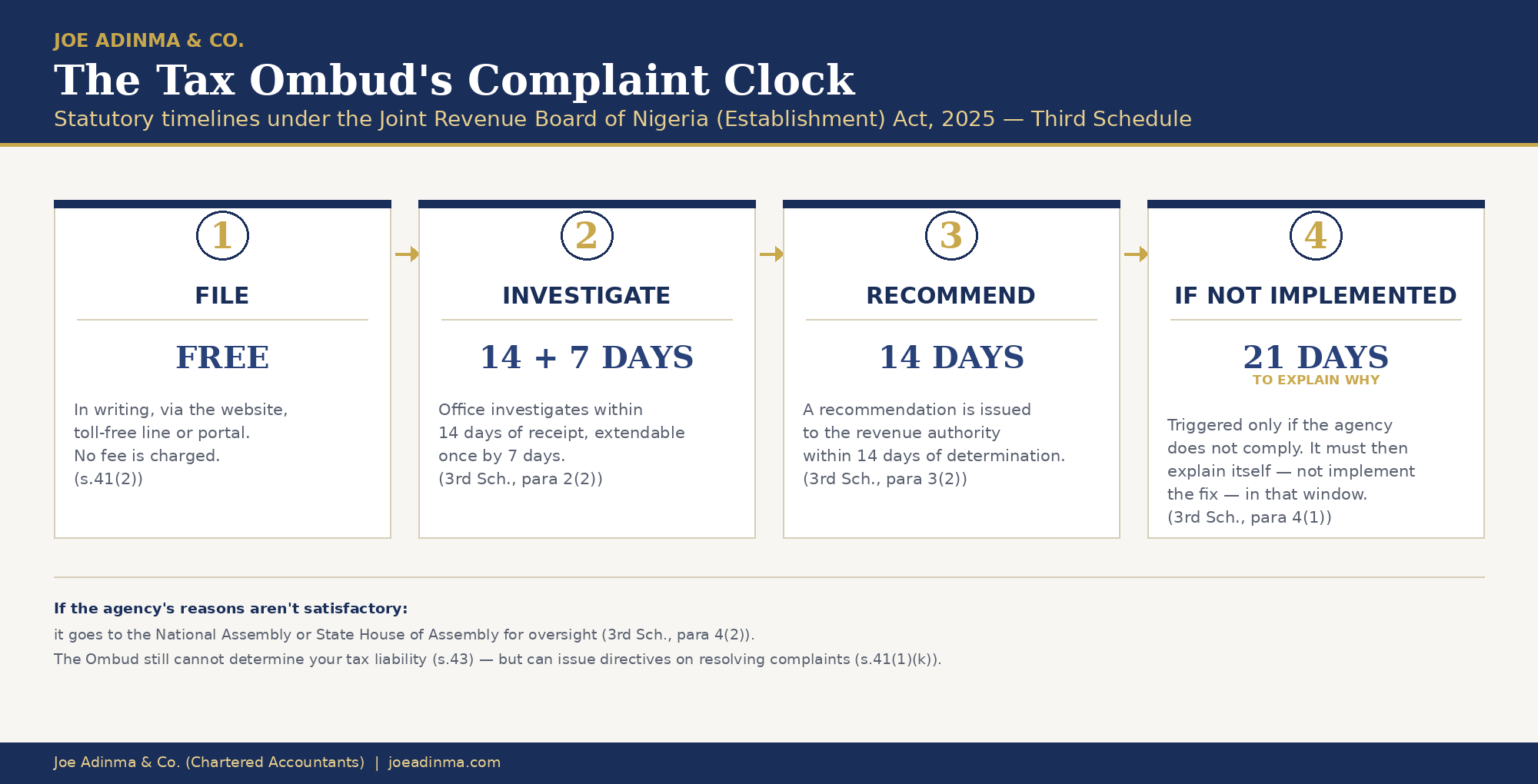
Investigation: within 14 days of receipt, extendable once by 7 days (3rd Sch., para 2(2)). If the Office decides not to investigate at all, it must tell you why within 7 days (3rd Sch., para 2(4)). Recommendation: issued within 14 days of determination (3rd Sch., para 3(2)). If the agency does not comply: it must report its reasons for non-compliance within 21 days (3rd Sch., para 4(1)) — and, as above, unsatisfactory reasons trigger a further escalation route. Keep your own paper trail against that clock — the office's channels (its website, a toll-free line and a digital case-tracking portal) were unveiled publicly in May 2026 specifically so complaints could be tracked “in real time.”
Before You File: What to Have Ready
Evidence that you raised the issue with the revenue authority first, and that it remains unresolved; your filing and correspondence references; acknowledgement emails or portal screenshots with dates; the assessment, payment or credit documents the complaint turns on; the names of officials you've dealt with; and a short, specific statement of what you want fixed. The Office's own portal and complaint form, which generates a tracking ID on submission, is at the Tax Ombud's “How to Lodge a Complaint” page (linked in Sources below).
Is This Actually Working?
It is early to say, and we'd rather say so than pretend otherwise. What's visible: a digital complaint portal and toll-free line since May 2026; a North-West roadshow through Kaduna and Sokoto; and a general “Taxpayer Bill of Rights” explainer now live on the office's website, describing in broad terms a right to be informed, treated fairly, kept private, and given timely resolution. That is not the separate, formally badged Taxpayer's Bill of Rights and Obligations the office said in August 2026 it would launch “in the coming weeks” — as of this writing, we found no confirmation that document has been published. The two shouldn't be confused.
An office that promises to answer, inside stated days, for silence it did not create, is still a newer idea in Nigerian tax administration than the tax itself — and newer ideas, like a new market stall, earn trust one transaction at a time, not by the sign above the door.
One commentator warned, before the office opened, that without real funding and enforcement teeth it risked becoming a “paper tiger.” The escalation routes described above are exactly the kind of teeth that warning assumed might be missing. Whether they get used is a separate question from whether they exist — and it's the more useful one to keep asking.
Eight Questions Before You Take a Complaint to the Tax Ombud
1. Have you already raised this with the relevant revenue authority, and does it remain unresolved? The Ombud can only take a complaint that clears this gate (3rd Sch., para 1(2)).
2. Is this about how you were treated — not about how much you owe?
3. Is the matter already before a court or the Tax Appeal Tribunal? If so, the Ombud cannot touch it (s.43).
4. Do you have a paper trail — filing references, dates, and records of what you submitted and when?
5. Is the authority in question the NRS, or a State Internal Revenue Service? This article covers the Federal/NRS side of the Ombud's jurisdiction only.
6. Are you asking the Ombud to settle a point of tax law, rather than a breakdown in process? That interpretive work sits with the Tribunal, not the Ombud.
7. If the revenue authority ignores a recommendation in your favour, are you prepared to ask the Ombud to use its escalation routes — referral to the National Assembly or State House of Assembly, or, for suspected misconduct, to a law enforcement agency — rather than assume nothing more can be done?
8. Have you logged your own dates, so you can hold the 14-, 7-, 14- and 21-day clock to account if it slips?
Closing
The printing press owner on Aba Road — illustrative, not a case on our file — doesn't need an ombud to tell her a credit is owed; that's between her and the NRS's own records. What she needs is somewhere whose entire job is to ask why an answer has taken this long, to put that question on a clock, and, if the clock is ignored, to say so to a body with the power to ask harder questions than she can ask alone. Nigeria has now built that address, with real statutory escalation routes behind it. Whether it's used — whether an ignored recommendation reaches the National Assembly, whether suspected misconduct reaches law enforcement, whether the Office's own quarterly reports (s.48(3)) name real, recurring problems — is the test that will tell Nigerian taxpayers what this office is actually worth. We'll be watching the same clock.
How Joe Adinma & Co. Can Help
If you're unsure whether a grievance belongs with the Tax Ombud, the Tax Appeal Tribunal, or neither, Joe Adinma & Co. can help you work out which door to use.
This article is for general information only and does not constitute tax or legal advice. The Office of the Tax Ombud is a new institution, and how its escalation powers are used in practice remains to be seen; readers should confirm current procedures directly with the office before relying on any detail here.
How We Sourced This
Section and paragraph citations (ss.36–38, 41, 43, 44, 48; Third Schedule paras 1(2), 2(2), 2(4), 3(2), 3(3), 4(1)–(2), s.49; Second Schedule paras 7(8), 9(2), 11(1)) were verified by independently fetching separately hosted copies of the Joint Revenue Board of Nigeria (Establishment) Act, 2025 official gazette text across two rounds of drafting, which returned consistent citations each time.
An earlier draft of this piece read the Ombud's recommendation power as effectively unenforceable. On review, we located the Third Schedule's National Assembly/State House referral mechanism and the s.41(1)(k) directives/orders power, and revised the analysis accordingly — while stopping short of asserting that an Ombud recommendation is judicially enforceable, which we found no authority for.
A further review round caught that paragraph 4(1) is narrower than first described: it requires the agency to report reasons for non-compliance within 21 days, not a general status report regardless of outcome. We verified the exact wording — “stating reasons for non-compliance with the recommendations” — against two independently hosted copies of the gazette text and corrected the body text, table and infographic accordingly.
The Act was assented to on 26 June 2025; the Tax Ombud's office began full operations on 1 January 2026.
One secondary source refers to a “Joint Revenue Board (Establishment) Act 2024.” This traces to the 2024 House Bill (HB.1758) that preceded the Act's 2025 passage and assent; we have relied on the enacted 2025 text throughout.
The office's website carries a general “Taxpayer Bill of Rights” explainer page (verified directly); we found no independent confirmation that the separate, formally announced Taxpayer's Bill of Rights and Obligations document (announced August 2026) has been published as of 2 October 2026.
Per our standing content policy, this piece covers Federal/NRS-administered complaints only. The Ombud's jurisdiction also extends to State Internal Revenue Services, Customs, NIMASA, NPA and CAC, which fall outside this article's scope.
The Aba Road scenario is an illustrative composite, not a documented client case.
Sources
Joint Revenue Board of Nigeria (Establishment) Act, 2025 — official gazette text
Daily Trust — Tax Ombud moves to tackle taxpayers' grievances in North-West
allAfrica — Tax Ombudsman to launch January 1, pledges impartiality, fairness
ACCA / AB Magazine — Can Nigeria's tax ombud make a difference?
Related Reading: “NRS Desk Review vs Tax Audit vs Tax Investigation: Why the Difference Matters” · “You Tried to File. The Portal Failed. Who Pays the Penalty?” · “The Tax Law Says One Thing. The NRS Portal Says Another.”